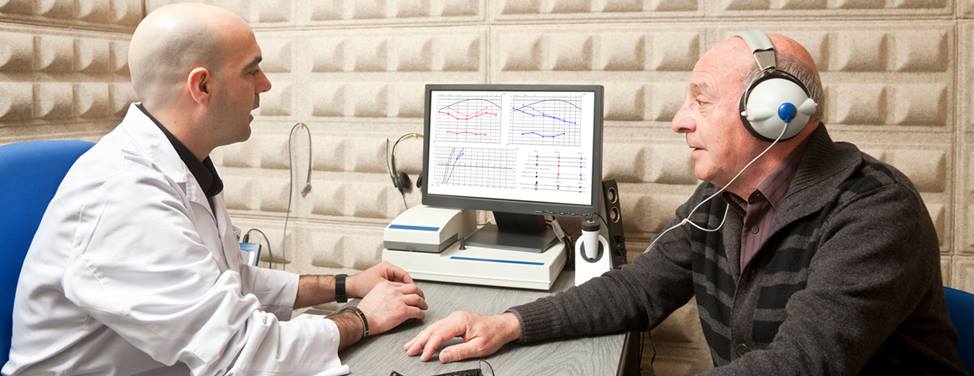




Hearing aids collect sounds from the environment, amplify them and direct the amplified signal into the ears. Once hearing loss has been confirmed, a communication needs assessment is necessary in order to determine if or which hearing aids would be appropriate for you.

Hearing Aids
You and your audiologist will examine, independently:
- Your communication needs.
- Preferred hearing aid style.
- Features of the devices.
The style of the hearing aid does not necessarily determine the sophistication of its electronic components or features.
Hearing aid styles
- Behind-the-ear (BTE). This type of instrument has two components — the hearing aid and the earmold. The hearing aid is worn behind the ear and connects to a custom-made earmold that fits in your ear. The earmold is created from an impression of the outer ear and ear canal. The impression is taken in the audiologist's office and is sent to a manufacturer for production.
- As the outer ear changes or grows, particularly in children, new earmolds should be made to maintain a proper fit. BTE hearing aids are suitable for all types and degrees of hearing loss and for persons of all ages. It is the most appropriate style for infants and young children and for people with severe hearing loss.
- Open-fit mini BTE. The newest style available, the open-fit mini BTE combines many of the acoustic benefits of the larger styles with the cosmetic benefits of the smaller styles. Open-fit instruments consist of a small BTE device, a narrow tube that hooks over and closely follows the contour of the front of the ear, and a soft, non-occluding piece that directs sound into the ear canal. The open fit allows natural sound to enter the ear canal for patients with good low frequency hearing. The instrument is very discreet and appealing to people with cosmetic concerns, and because it does not require custom molding, it often can be selected, programmed and fit in a single visit.
- In-the-ear (ITE). The hearing aid is built into a custom-made shell made from an impression of the outer ear. The ITE is most appropriate for mild to moderate hearing losses. This style is not appropriate for infants or young children.
- In-the-canal (ITC). The hearing aid is built into a custom-made shell obtained from an impression of the ear canal. This style is most appropriate for people with mild to moderate hearing loss. While this is one of the smallest hearing aid styles available, it may not be appropriate for certain degrees and configurations of hearing loss. It is not appropriate for infants or young children.
- Completely-in-the-canal (CIC). Like the ITC, the hearing aid is built into a custom-made shell made from an impression of the ear canal. The difference between the CIC and the ITC is that the CIC fits a bit further into the ear canal and often extends deeper toward the eardrum. This aid is often the most hidden cosmetically, but is not invisible. This style of hearing aid is most appropriate for mild to moderate hearing loss, and may not be appropriate for certain configurations of hearing loss. This style is not appropriate for infants or young children.
Digital hearing aids
Most hearing aids sold today contain digital circuitry. Digital hearing aids analyze incoming sound and convert it to a digital signal. The signal can then be manipulated according to an individual's hearing levels and listening needs, reconverted to an analog form (sound waves) and delivered to the ears, without producing the distortion commonly associated with analog technology. In addition, these devices are often superior in terms of programming flexibility, advanced circuit compression (amplifying soft sounds but not over-amplifying loud sounds), improved noise reduction, multiple programs, and the ability to minimize acoustic feedback.
Many digital hearing aids also have a directional microphone option, which helps with hearing in noisy environments. Digital hearing aids are available with different levels of sophistication, making them an affordable option for many people.
Continue reading
Communication needs assessment and hearing aid evaluation
In order to establish the appropriate plan of action, you must have had a complete hearing test performed by an audiologist within the previous six months.
If you have not had a recent hearing test, you can have one performed at the UCSF Audiology Clinic. Once the hearing test is done, your communication needs will be determined. Check with your insurance to determine your coverage prior to making the appointment. If hearing tests are not covered by your insurance, there will be an additional fee for the evaluation.
Costs
At UCSF Medical Center, the self-pay cost for the various types of hearing aids range from $1,500 to $4,000 per hearing aid. Most patients who have hearing loss in both ears use binaural (two) hearing aids.
Insurance coverage and Medicare
Medicare does not cover the cost of a hearing test, hearing aid evaluation or hearing aids. Coverage for hearing aids from private insurance varies. Please contact your insurance company directly to determine whether or not your policy includes hearing aids as a covered benefit and whether UCSF is a provider of hearing aids for your policy.
The UCSF Audiology Clinic can bill insurance companies for hearing aids, but be aware that this often requires preauthorization from the insurance company. If your insurance company does not pay the claim once it is submitted, you will be responsible for the full cost of the hearing aids.
We now offer Hearing Loss Information and Education (Aural Rehabilitation) classes. Call (415) 353-2101 for information.
UCSF Health medical specialists have reviewed this information. It is for educational purposes only and is not intended to replace the advice of your doctor or other health care provider. We encourage you to discuss any questions or concerns you may have with your provider.