

Learning never stops
Our classroom and bedside classes help kids get credit and keep learning during treatment.
See our school program




Here to serve you
Explore our network of care for kids, from the tiniest to teens and young adults.




World-class docs
We'll help you find the best provider for your child.




Stress-free visits
Accommodations. Admission. Discharge. Procedure prep. We've got you covered.



Extraordinary kid care
Our specialists handle conditions ranging from the common to the most rare.




Referrals made easy
Contacts and resources to get your patients to our pediatric specialists




Best in Northern CA
We're ranked #1 in pediatric cancer, heart surgery, cardiology & more.





Scoliosis means abnormal curvature of the spine greater than 10 degrees, as measured on an X-ray. Anything less than 10 degrees is considered normal variation in a normal individual. The curvature takes place in three dimensions.
Normally, the spine is straight when looking at a person from the front or back. When looking at a person from the side, the spine is curved. There is a gentle bending forward of the spine in the chest and a bending backward, called lordosis, between the chest and the pelvis.
In scoliosis, the spine appears S-shaped when looking at the front or back. When looking at the side, the normally curved spine typically straightens out. In addition, the spine twists on its axis, pushing the ribs and flanks backward and forward to produce a prominence, or hump.
Scoliosis may be divided into five principal types:
Progressive, severe scoliosis can produce three major problems:
Idiopathic scoliosis usually isn't painful. About 30 percent of patients with scoliosis have back pain, which is the same percentage found in children without scoliosis. There are certain exceptions in which an associated disease of the central nervous system, such as a fluid collection in the spinal cord, may produce pain as well as scoliosis.
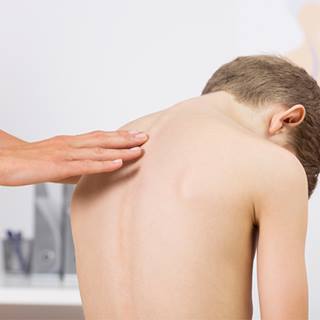
Scoliosis can be diagnosed with a physical examination by a school nurse, pediatrician or orthopedic surgeon. The principal sign is asymmetry of the back, as the spine bends sideways and twists. Most commonly, this is detected by noticing a hump on the ribs or flank, between the ribs and hip, after asking the child to bend forward. The tilt produced in the back can be measured in degrees by a level; seven degrees or more is considered significant for scoliosis.
Other signs of scoliosis include elevation of one shoulder compared with the other, tilting of the pelvis – which may make one leg appear shorter than the other – and a difference in the contours of the flanks.
The next step after the physical examination is an X-ray of the spine.
Certain types of scoliosis are associated with other diseases, such as kidney disease. If a child with scoliosis is suspected of having an underlying disease, other tests may be necessary. Symptoms of possible underlying disease include significant pain, pigmented markings or a hairy patch on the skin or a deformity of the foot. Tests for underlying disease may include an ultrasound to look for kidney disease and a magnetic resonance imaging (MRI) study to look for an abnormality of the nervous system.
There's no clear evidence that untreated scoliosis, or scoliosis treated with bracing or spinal fusion, will increase the risk of back pain or arthritis in the long term.
The younger a child, or the more she or he has to grow, the greater the risk of scoliosis progressing. After puberty, curves less than 50 degrees are not likely to get worse. For this reason, the ultimate goal of scoliosis management is to keep curves under 50 degrees until your child has matured.
Children with curves less than 50 degrees typically grow up into adults with no significant problems related to scoliosis.
Scoliosis treatment is based on the degree of curvature of the spine, viewed from the front or back by X-ray. The following are general guidelines for treatment.
This is not scoliosis. Scoliosis is defined as spinal curvature greater than 10 degrees. Curvature under 10 degrees is considered a normal variation, just as there is a normal range for weight and height.
In this range, scoliosis is observed for progression. The measurement error in reading X-rays is up to four degrees. This means that a difference of four degrees between office visits may not be real, but rather is a reflection of the inherent inaccuracies of measuring X-rays. Partly because of this, significant progression is defined as an increase in curvature of at least five degrees. The typical rate of progression is one degree per month, so it would take at least five months to see significant progression. As a result, the child is seen every six months for follow-up, which includes both physical and X-ray examinations.
In this range, bracing is the standard of care in the United States. The scoliosis brace is known as a TLSO, which stands for thoraco-lumbar spinal orthotic. The idea behind bracing is to stop or slow progression of the curve so that it stays under 50 degrees. An X-ray of a brace shows that the brace can straighten the spine, but the spine will return to its original curvature when the brace is removed. The two principal types used are the Milwaukee brace, developed by Dr. Walter Blount of Milwaukee, and the Boston brace, developed by Dr. John Hall of Boston.
The brace is worn more than 20 hours per day. Time is allowed out of the brace for hygiene and for sports. Part-time bracing doesn't work as well and may not work at all. The child is weaned into the custom-made brace gradually over a two-week period. This allows the child to adjust and prevents significant skin irritation from the brace. After two weeks of full-time wear, or approximately four weeks after initial fitting of the brace, the child is seen in the office for X-rays in the brace.
Successful bracing reduces the curve by half or better as determined by X-rays. At later visits, X-rays are taken out of the brace, which is removed the night before to allow full relaxation of the spine and a more realistic measure of the degree of curvature. Brace treatment successfully stops curve progression in about 80 percent of children.
Beyond 50 degrees, the spine loses its ability to compensate and progression becomes inevitable even after the child is mature. The only way to stop progression at this stage is a surgery called spinal fusion. Think of the vertebrae as beads on a string. The spine bends between the vertebrae as a string bends between the beads, causing the beads to move. The way to stop the beads from moving is to stick them together. Spinal fusion surgery joins the vertebrae.
Spinal fusion surgery
Our pediatric orthopedic surgeons perform spinal fusion surgery, which corrects severe scoliosis by connecting spinal bones.
Learn more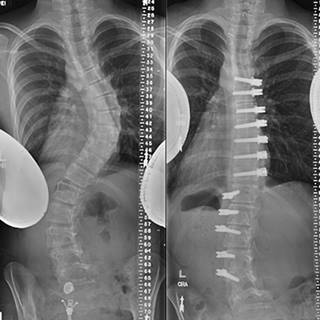
Vertebral body tethering
This surgery for scoliosis uses your child's own growth to straighten the spine and may offer advantages over traditional approaches.
Learn moreUCSF Benioff Children's Hospitals medical specialists have reviewed this information. It is for educational purposes only and is not intended to replace the advice of your child's doctor or other health care provider. We encourage you to discuss any questions or concerns you may have with your child's provider.

Open-label Placebo (COLP) for Pain in Adolescent Idiopathic Scoliosis (AIS) Surgery+Surgical Tr...
Oral morphine equivalents (OMEs) are values that represent the potency of an opioid dose relative to morphine. Using OMEs provides a standardized method for converting between various opiate medications. Each oral opioid dose is a...
Recruiting
More about this study
One of the nation's best in orthopedics

Ranked among the nation's best in 10 specialties
Learning never stops