
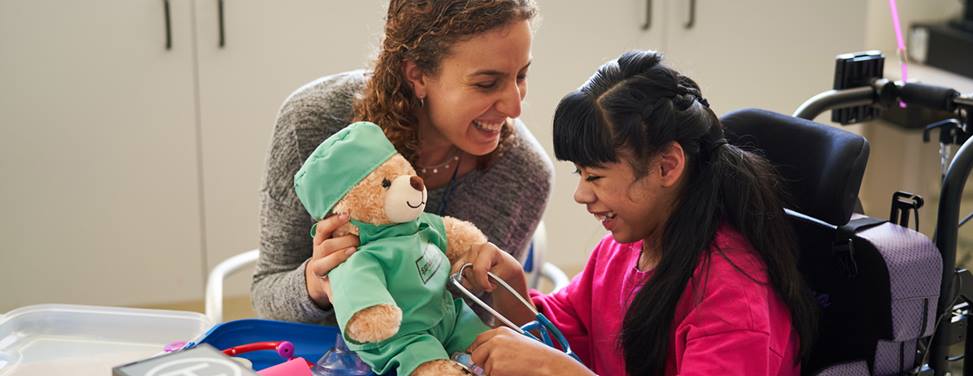



Learning never stops
Our classroom and bedside classes help kids get credit and keep learning during treatment.
See our school program




Here to serve you
Explore our network of care for kids, from the tiniest to teens and young adults.




World-class docs
We'll help you find the best provider for your child.




Stress-free visits
Accommodations. Admission. Discharge. Procedure prep. We've got you covered.




Extraordinary kid care
Our specialists handle conditions ranging from the common to the most rare.




Referrals made easy
Contacts and resources to get your patients to our pediatric specialists




Best in Northern CA
We're ranked #1 in pediatric cancer, heart surgery, cardiology & more.





Inflammatory bowel disease, or IBD, is a blanket term that includes several chronic diseases. These diseases interfere with the normal function of the intestine (also called the bowel), cause inflammation of the small and large bowel and, in some cases, ulcers, which are open sores of the mucous membrane. Symptoms vary widely from child to child.
Inflammatory bowel disease can affect people of all ages and is more commonly found in those who have family members with the disease. The cause is not understood. The two most common types of IBD are ulcerative colitis and Crohn's disease.
Ulcerative colitis causes swelling, inflammation and ulceration of the lining of the large bowel. The small bowel usually remains healthy.
Crohn's disease causes inflammation and ulceration of all layers of the small bowel, the large bowel or both. Crohn's disease can skip areas of the bowel so there may be sections of healthy bowel between diseased bowel.
Symptoms include a change in bowel habits, usually diarrhea. There may be blood, mucous and pus in the stool.
Other symptoms may include:
The diagnosis of IBD can be made by examining the bowel with a telescope called an endoscope or with special X-rays called a gastrointestinal exam to look for inflammation and ulcers of the bowel. Tissue samples, called biopsies, are taken to be examined by a pathologist (a doctor trained to analyze such samples) for signs of IBD.
Most children with IBD do not need an operation. There are many medications available for treatment, which generally fall into two categories: anti-inflammatory and immunosuppressive medications. The majority of children with IBD do well on these medications.
Some children with ulcerative colitis, however, have such severe symptoms that an operation is recommended. In this operation, the pediatric surgeon removes the large intestine and pulls the small intestine to the anus in a procedure called a pull-through. A pouch is made at the end of the intestine to help collect stool between bowel movements.
In many children this can be done in a single operation, but some children need two operations or stages. During the first operation, the colon is removed, a pouch is created and a temporary ileostomy is made. Ileostomy involves bringing the portion of the small bowel that empties into the large bowel, called the ileum, out to an opening on the abdomen. Stool flows out the opening and is collected in a bag that sticks to the skin. Several months later, during the second operation, the ileostomy is closed and the intestine reconnected so stool flows into the pouch and out the anus.
Children with Crohn's disease usually aren't treated with surgery, since the disease can return and is not cured with an operation. Crohn's disease can affect the entire bowel, not just a portion. If a part of bowel is removed, Crohn's disease can occur in the remaining bowel. However, children with Crohn's disease may need an operation to relieve a bowel obstruction, drain an abscess (pocket of infection) or drain fistulae, abnormal tube-like connections from the bowel to the skin.
UCSF Benioff Children's Hospitals medical specialists have reviewed this information. It is for educational purposes only and is not intended to replace the advice of your child's doctor or other health care provider. We encourage you to discuss any questions or concerns you may have with your child's provider.
Best in Northern California for gastroenterology & GI surgery
Ranked among the nation's best in 10 specialties
Learning never stops