
Robotic Surgery: Improving Precision and Patient Outcomes
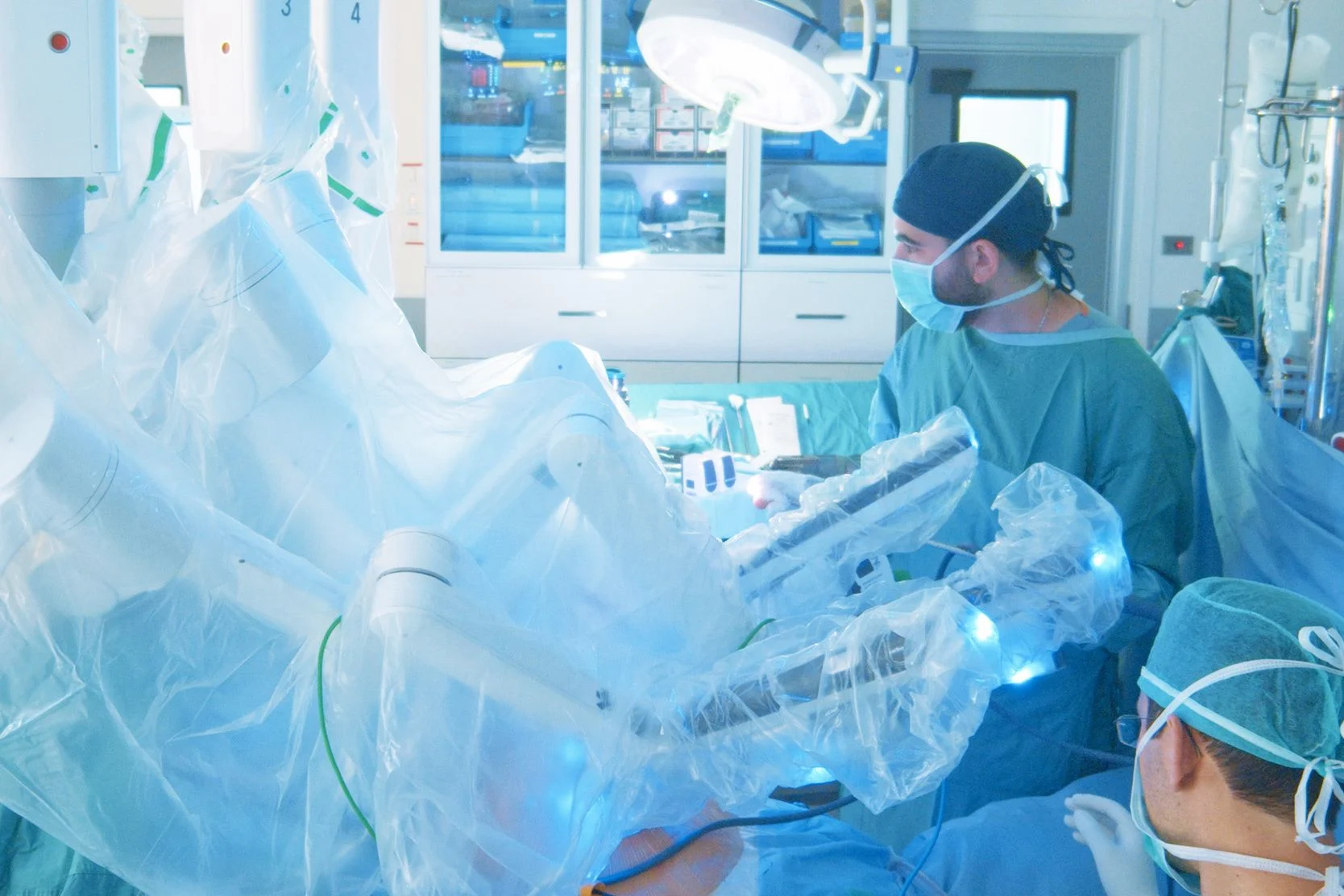
Robotic surgery is on the rise: It now accounts for about 22% of surgeries performed in the United States. Health data shows that robot-assisted surgeries improve patient outcomes, but many people are still wondering, "What are they? And how do they work?"
For answers, we sat down with thoracic surgeon Dr. Johannes Kratz, medical director of the UCSF Robotic Surgery Program. Under his leadership, the program has grown year over year, with UCSF providers now performing robotic surgery for chest, stomach and intestinal, colon and rectal, urologic, gynecologic, heart, otolaryngological (ear, nose and throat), head and neck, and bariatric (obesity-related) conditions. Kratz shares common misconceptions about robotic surgery, explains why its use is rapidly expanding, and discusses which types of procedures typically benefit from this technology.
How does robotic surgery work?
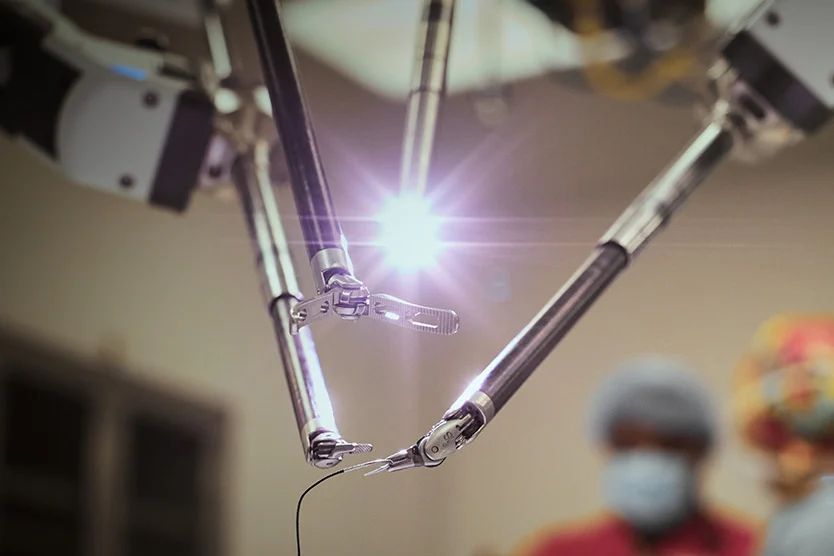
Instead of the surgeon's hands being inside the patient during the operation, there are miniaturized robotic hands inside the patient that the surgeon controls. We are linked up to very sophisticated controllers that attach to our fingers. When we move our hands around in space, the robotic hands inside the patient move in the same way. It's like virtual reality when you put your hand inside a glove. And then, when you move the glove, you see the glove move on the computer screen. It's a very similar sort of interface.
What are some misconceptions about robotic surgery?
When people hear "robotic surgery," they imagine that the surgery is automated like a self-driving car. I commonly have to correct that misperception and explain that the surgeon is actually operating, and the robot is just an interface between the surgeon and the instruments.
To me, "robotic surgery" is a little bit of a misnomer. It is actually "robot-assisted surgery." It's a move from analog surgery, where the surgeon directly controls an instrument, to digital surgery, where the surgeon controls an instrument virtually through a very sophisticated computer-assisted interface several feet away from the patient.
The advantage of robot-assisted surgery is that the instrumentation is so much more precise.
What is the difference between robot-assisted surgery and other types of minimally invasive surgery?
Robot-assisted surgery is similar in terms of invasiveness – number of incisions, outcomes and recovery time – to arthroscopic and laparoscopic surgeries, where a surgeon makes one or two small incisions in the skin and uses small instruments and cameras below the skin to do the surgery. The advantage of robot-assisted surgery is that the instrumentation is so much more precise.
What is robot-assisted surgery especially good for?
Narrow and tight areas in the body can make traditional surgery difficult. For example, the pelvis is a very narrow part of the body and there are gynecological and urologic conditions that must be treated in those tight spaces. I don't think it's a coincidence that urologists and gynecologists really popularized robotic surgery. They showed the rest of the surgical community that surgery was possible with robots that could assist in various aspects of minimally invasive surgery.
Surgeons have also found that superior instrumentation can help in more open areas of the body by getting around tight corners and seeing things better with 3D visualization.
How has robot-assisted surgery changed the surgery landscape?
Not only can many less invasive surgeries be done as robot-assisted surgeries now, but a growing number of sophisticated or very difficult open [traditional] surgeries are shifting to robot-assisted as well.
You're a chest surgeon. What impact has robot-assisted surgery had there?
In my specialty, thoracic surgery, minimally invasive cases in the U.S. plateaued at around 40% until the advent of robotics. And now, with robot-assisted surgery, that number has shot up to about 70% for most standard lobectomies [removing a lung lobe to treat a tumor or an infection, such as tuberculosis]. It opens up more possibilities for surgeons to operate minimally invasively with robotics, because the instrumentation is better.
UCSF hit a milestone of 15,000 robotic surgeries last year. How does UCSF's robot-assisted surgery program differ from those of other institutions?
I think it's our experience and the variety of robotic surgeries that we offer. UCSF is one of the highest volume centers for robot-assisted surgery among academic medical centers in the western U.S. It's very rare to offer the sort of breadth we do and the volume that we do.
Can you talk about the teaching and training for robotic surgery?
UCSF has become a comprehensive surgery training center – one of the best in the country and potentially the world – because of our expertise, the number of robotic surgeons we have and the number of specialties that participate in robotic surgery. I think we're doing a good job of educating the next generation for robotic surgery.
What new types of procedures do you see being done robotically?
I think one of the areas with the most potential is more robot-assisted cardiac surgery. I would say both minimally invasive and robotic cardiac operations in the U.S. are still not as high as they could be. Instrumentation is getting more sophisticated and robotic surgery could help convert open cases to minimally invasive cases, making that a more appealing option to patients versus the catheter-based approaches that are commonly being used for patients.
Do you think robot-assisted surgery is going to become the predominant mode of surgery? Or will open and other minimally invasive types still have roles to play?
I think it will become the most popular way of performing complex, minimally invasive cases. But there are some cases that are very simple and don't require robotic surgery. As an analogy, driving a car is great, but you're not going to drive to your next-door neighbor's house. There are certain simple tasks for which technology is incredible, but it can be unnecessary for others. Conversely, there are also cases that are too complicated for using minimally invasive techniques and it's for safety reasons that you have to do them as open surgeries, at least in my specialty.
Innovation in robotic surgery
Related clinics
Robotic Surgery
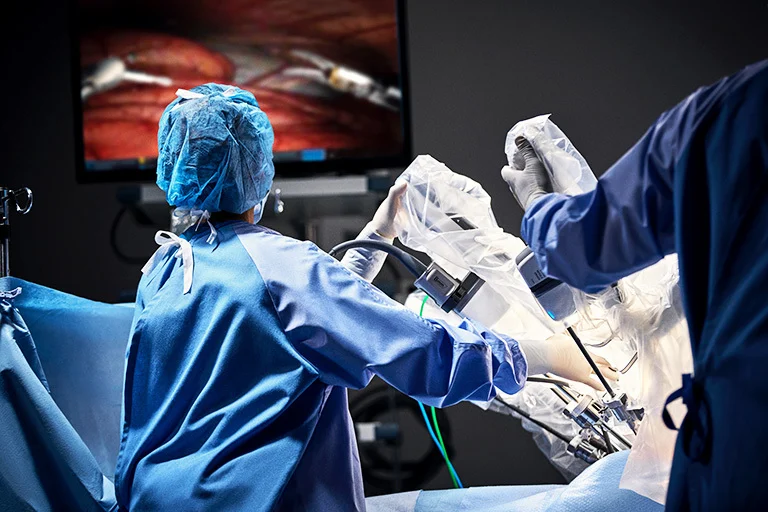
During robotic surgery, surgeons control robotic arms equipped with tiny surgical tools, which increases precision and reduces your risk of complications.
UCSF Health medical specialists have reviewed this information. It is for educational purposes only and is not intended to replace the advice of your doctor or other health care provider. We encourage you to discuss any questions or concerns you may have with your provider.